 Panacea Bio Chem Formulation-State Monograph
Journal-style technology note
Panacea Bio Chem Formulation-State Monograph
Journal-style technology noteCold high-viscosity conditioning · Rev. Jul 2026
Panacea Bio Chem Formulation-State Monograph
Journal-style technology note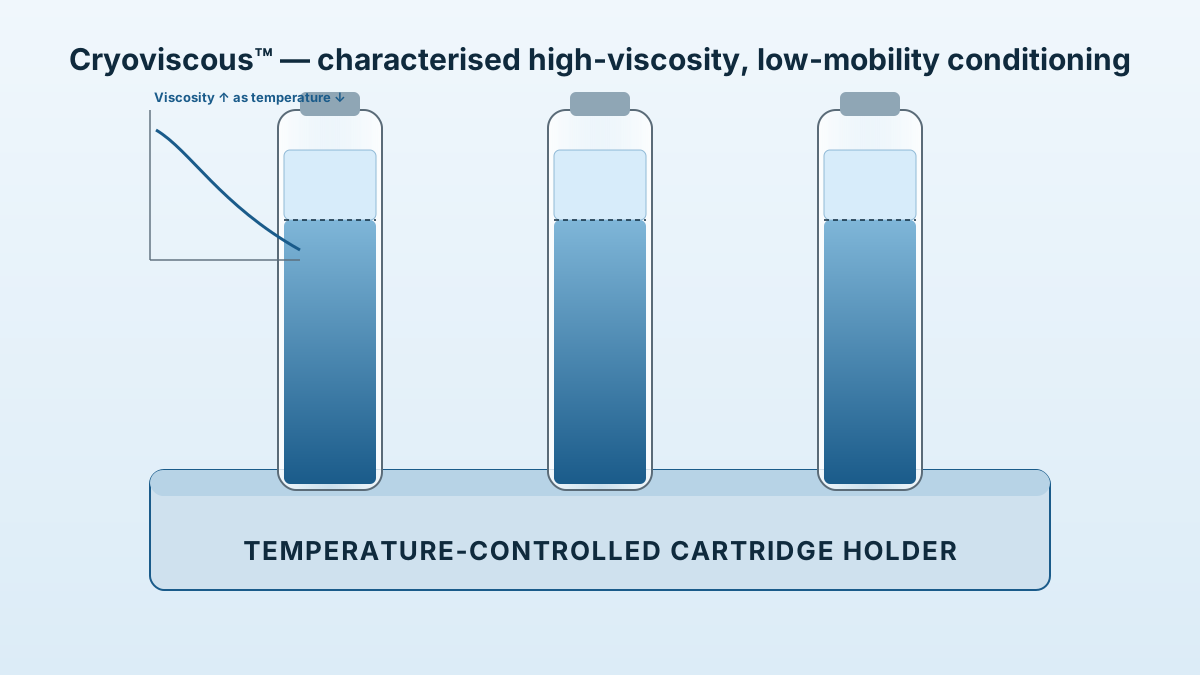
Cryoviscous™ is Panacea Bio Chem's proprietary name for a characterised, temperature-induced high-viscosity, low-mobility processing state of the API-containing primary formulation, near the boundary between a freely-flowing liquid and a semisolid. It is Panacea's proprietary designation for a characterised state — not an established universal pharmacopeial classification. In this state the formulation temporarily and strongly restricts flow — damping convection, downward liquid penetration and rapid intermixing — which is exactly what lets a lighter, warmer completion medium rest above it during a fill without the two blending. The set-point is formulation-specific, characterised by each formulation's viscosity, phase behaviour and recovery profile — not a fixed temperature. The formulation is held in this low-mobility state without changing its total API content or the rear-plunger datum; no intentional chemical transformation is introduced, and it is recoverable within formulation-specific acceptance criteria on controlled warming. It is "cold liquid" done as a characterised state, not merely chilled. The conditioning parameters and targets remain proprietary to Panacea Bio Chem.
Also indexed as: cold high-viscosity conditioning · temperature-induced viscosity control · controlled-warming recovery · low-mobility fill state · no-mix cartridge filling · viscosity-vs-temperature conditioning window.
For many pharmaceutical liquid systems, viscosity increases as temperature falls; the magnitude and shape of that rise are formulation-specific. Some formulations pass through a usable high-viscosity window before undesirable freezing, crystallisation, glass formation, precipitation or irreversible gelation — still technically a liquid, but slow, cohesive and strongly flow-restricted. Cryoviscous is Panacea Bio Chem's name for deliberately steering a formulation into that window and holding it there; characterisation determines whether such a window exists for a given formulation and where. It is not an accident of the cold chain; it is a designed, characterised operating point.
In the Cryoviscous state the API-containing primary formulation is thick enough to temporarily resist the things that would otherwise ruin a delicate fill: turbulence, thermal convection currents, a heavier liquid sinking down through it, and rapid intermixing. It is, in the marketing sense, a formulation held still — more precisely, one temporarily rendered low-mobility and flow-restricted. Crucially, no intentional chemical transformation is introduced: total composition and API content remain unchanged, while phase behaviour and recovery are monitored to exclude unacceptable physical or chemical change. The intended change is rheological and physical rather than compositional, and only for as long as the cold is maintained.
The tempting shortcut is to say "chill it to near freezing and it will be thick enough". Panacea's position is that this is not enough. Different formulations — different solids content, different excipients, different peptides or cofactors, different pH and ionic strength — reach a usable high-viscosity, low-mobility window at different temperatures, and some will glass, gel, crystallise, phase-separate or begin to nucleate ice before they ever reach the target if the temperature is chosen blindly.
So the Cryoviscous state is defined by measurement, not by a thermometer reading. For each formulation, Panacea characterises three things: how its viscosity climbs as temperature falls, its phase behaviour (where it would gel, glass or nucleate), and its recovery profile (how completely and how quickly it flows and homogenises again on warming). The conditioning temperature is then the one that lands the formulation squarely in the high-viscosity, low-mobility window — deep enough to resist mixing, short of any unacceptable phase transition — freezing, crystallisation, glass formation, precipitation or irreversible gelation.
The whole idea lives in one curve. As temperature falls, apparent viscosity rises — gently at first, then steeply as the formulation approaches its low-temperature domain. The Cryoviscous window is the shaded band: high enough on the viscosity axis to hold the formulation still, but stopping short of the freezing, crystallisation, glass and gel regions where the change would no longer be a clean, recoverable one. Its position is formulation-specific and characterised.
The Cryoviscous state exists to serve a single, elegant manufacturing moment. When a cartridge is completed, a lighter, warmer, API-free ElimiVoid™ completion medium → is delivered gently above the primary formulation by the ElimiVoid™ Process to fill the geometric void — without moving the rear plunger or disturbing the primary API-containing aliquot; the drawback withdraws only the excess API-free completion medium, and the API-per-increment is unchanged. For that to work cleanly, the two liquids must not turbulently blend during the pour.
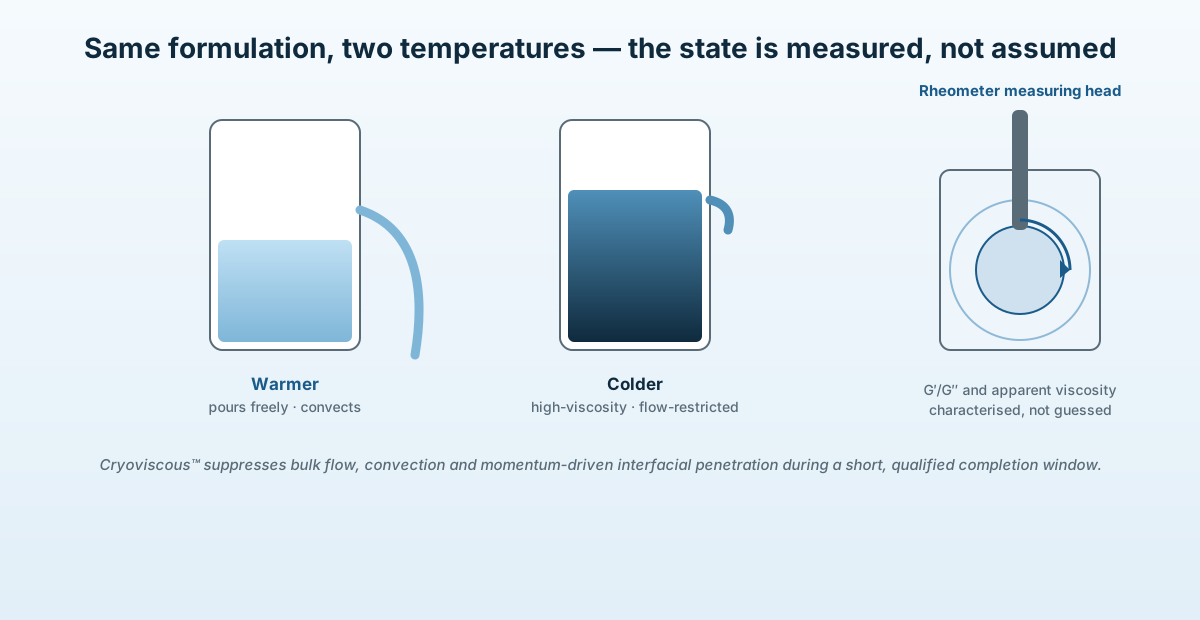
A freely-flowing liquid would mix on contact: convection, density-driven sinking and the disturbance of the incoming stream would all stir the interface. A Cryoviscous formulation does not. Its high viscosity damps convection, resists the downward penetration of the lighter layer, and reduces convective mixing and limits interfacial mass transfer during the short, qualified completion window — long enough for the completion step to finish. When the ElimiVoid™ completion medium first contacts the Cryoviscous™ primary formulation, a transient first-contact interfacial barrier forms under the defined process conditions, protecting the primary aliquot during completion and excess withdrawal. It is a single-cycle, contact-induced structuring, not a repeatable temperature-driven two-phase system. Homogenisation happens above the formulation-specific interface-release temperature; after controlled warming and homogenisation, the original interface does not re-form during the qualified subsequent temperature cycle. Cryoviscous provides the mechanical stillness; ElimiVoid provides the interfacial completion. They are two halves of one idea.
A characterised, temperature-induced high-viscosity, low-mobility processing state of the API-containing primary formulation, near the boundary between a freely-flowing liquid and a semisolid.
Temporarily holds the formulation in a low-mobility, flow-restricted state — suppressing bulk flow and damping turbulence, convection, downward penetration and rapid intermixing — so a completion medium can sit above it during the fill without blending.
Formulation-specific. Characterised by each formulation's viscosity climb, phase behaviour and recovery profile — not a fixed temperature.
Total API content and the rear-plunger datum are untouched. No intentional chemical transformation is introduced; the intended change is rheological and physical, and only while the cold is held. Phase behaviour and recovery are monitored to exclude unacceptable change.
Recoverable within formulation-specific acceptance criteria. Controlled warming restores the required flow and homogenisation behaviour within the qualified recovery profile (established via viscosity return, homogeneity and API assay).
| Dimension | Simple chilling | Cryoviscous conditioning |
|---|---|---|
| Setpoint | A nominal chilling temperature | Characterised per formulation to a rheological target |
| Goal | Colder product | A defined high-viscosity, low-mobility state |
| Mixing control | Convection & blending not specifically controlled | Bulk flow, convection & momentum-driven penetration suppressed |
| Phase risk | Freeze / crystallisation / precipitation / gel / glass not mapped | Window mapped short of freeze, crystallisation, precipitation, gelation & glass |
| Dose & plunger | Unchanged | Unchanged |
| Recovery | Assumed | Measured — viscosity return, homogeneity & API assay |
Cryoviscous is the conditioning step inside the Liquiprester™ liquid-cartridge platform →, produced on the shared PleniDose™ Gantry →. The gantry coordinates the conditioning of the primary formulation into the Cryoviscous state through temperature-controlled cartridge holders, then performs the ElimiVoid™ Process completion above it — a slow top-up and a fast, calibrated drawback of the excess API-free completion medium at the meniscus.
Around that moment sit the rest of the controls. The fill liquids are degassed by OxyDeplete™ → and argon-conditioned by ArgonLock™ →, so that between degassing, argon conditioning and the void being filled with liquid rather than gas, the finished cartridge carries no visible air bubble within a near-airless, oxygen-depleted and argon-conditioned internal environment — the deliberate, compressible front gas pocket eliminated and residual oxygen driven low. Oxidation-sensitive actives are further shielded by RedoxVault™ →, and the real dose delivered per pen increment is mapped and verified by IncreSure™ →. Cryoviscous is the quiet enabling step: without the stillness it creates, the precision completion above it would not hold.
Panacea Bio Chem researches cold high-viscosity conditioning as an ongoing programme, of which Cryoviscous is the working state. The team's position is that the useful variable is not temperature but the high-viscosity, low-mobility processing state — that "hold the formulation still" is a measurable, formulation-specific target, and that the honest way to reach it is to characterise each formulation rather than to trust a single chilling temperature.
Panacea's contribution with Cryoviscous is the framing and the method: treating the cold state as a characterised high-viscosity, low-mobility operating point that holds a formulation in a flow-restricted state for a precision fill and then releases it within the qualified recovery profile — without touching the dose, the plunger or the chemistry. The outline is public; the recipe is not.
Cryoviscous™ is a proprietary Panacea Bio Chem processing-state technology developed and invented by Bogdan Dicoias. Its formulation-specific conditioning parameters and acceptance criteria are not publicly disclosed.
What Panacea will say plainly is the boundary: the conditioning temperatures, viscosity targets, acceptance windows and per-formulation recovery profiles are a proprietary secret held by Bogdan Dicoias and not disclosed. The principle is here; the numbers stay in-house.
Using cold to change how a material flows, not merely to preserve it, is well founded in pharmaceutical processing and rheology. Rheologists have mapped for a century how viscosity climbs as temperature falls1, how viscoelastic2 materials store and release deformation (a general phenomenon that oscillatory measurement can quantify), and the broader science of flow and deformation4. Low-temperature viscosity control is used to suppress convection6 and momentum-driven mixing; shear- and thermal-recovery behaviour is characterised so a conditioned state can be returned; and freeze-concentration and glass formation3 are precisely the transitions such conditioning is deliberately kept short of. Cryoviscous takes that lineage of thermally-conditioned, characterised pharmaceutical processing and points it at one precise job: hold a formulation in a low-mobility state, on purpose, for exactly as long as a precision fill needs — then return it within its qualified recovery profile on warming.
What is the Cryoviscous state?
Cryoviscous is Panacea Bio Chem's
proprietary name for a characterised, temperature-induced high-viscosity, low-mobility
processing state of the API-containing primary formulation, near the boundary between a
freely-flowing liquid and a semisolid. It is Panacea's proprietary designation for a
characterised state — not an established universal pharmacopeial classification. It
temporarily and strongly restricts flow, damping convection and rapid intermixing, and
homogenises again on controlled warming.
Is Cryoviscous just cold liquid?
No. It is cold done as a characterised
state, not merely chilling to a fixed temperature. The set-point is formulation-specific,
characterised by each formulation's viscosity, phase behaviour and recovery profile, so the
state hits a defined rheological target.
Does it change the amount of API or the plunger position?
No. The formulation is
temporarily held in a low-mobility, flow-restricted state without changing its total API
content or the rear-plunger datum. It is a physical, rheological state, recoverable within
formulation-specific acceptance criteria on controlled warming.
Who developed the Cryoviscous state?
It was developed by Bogdan Dicoias and
is the intellectual property of Panacea Bio Chem Ltd — alongside ElimiVoid™,
IncreSure™, RedoxVault™, OxyDeplete™, ArgonLock™ and the
Liquiprester™ platform.
Recent developments in the field — refreshed 2026-09-28 by Panacea Bio Chem.
The Panacea Technology Universe
Proprietary Panacea Bio Chem Ltd technologies, invented by Bogdan Dicoias — what each one does, and why it leads its class.
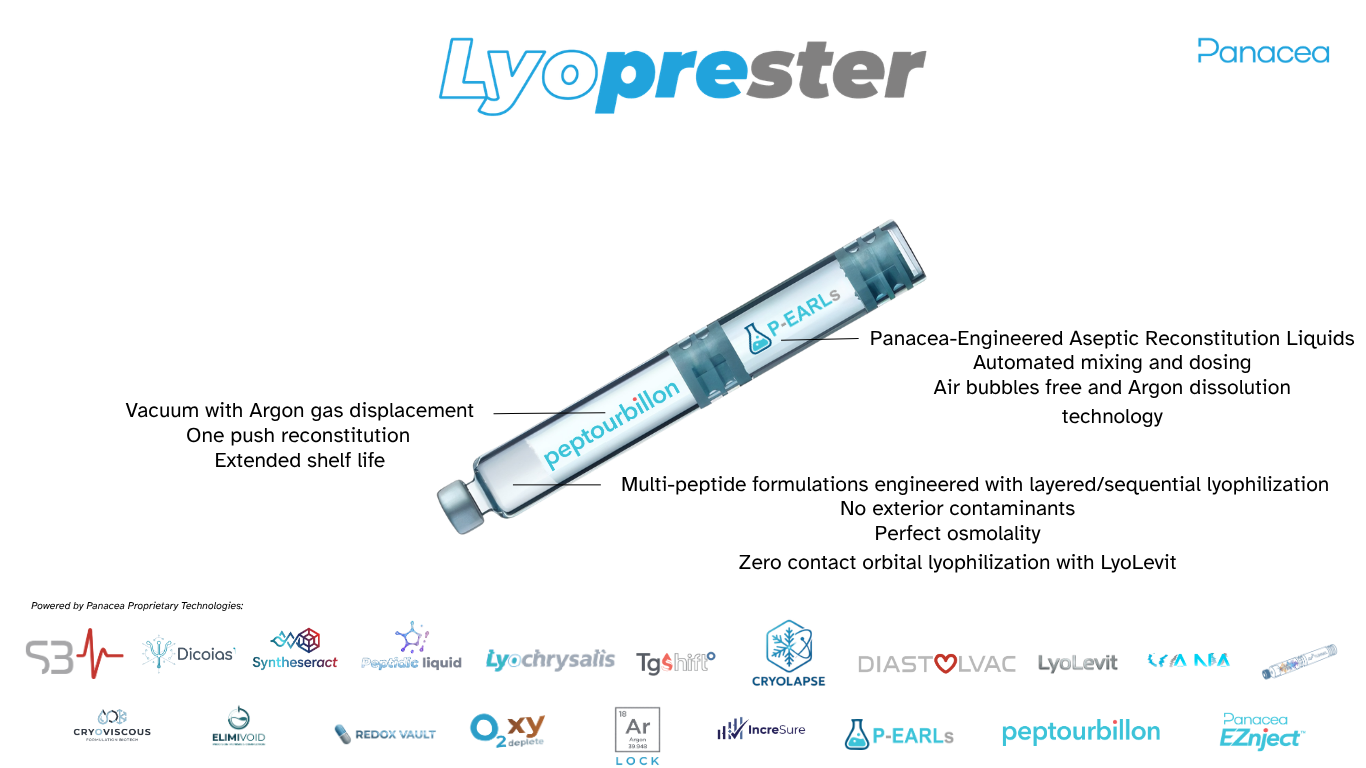
 Lyoprester®The only dual-chamber cartridge that is autoreconstitution-enabled, vacuum-sealed and argon-fillback.lyoprester.com ↗
 P-EARLs™Panacea-Engineered Aseptic Reconstitution Liquid(s) — each tuned to the peptide it wakes.p-earls.com ↗
 Peptourbillon™The layered peptide formulation architecture — single- or multi-layer, never a blend.peptourbillon.com ↗
 RF Tunnel™The RF-formed central channel through the cake.rftunnel.com ↗
 TgShift™Raises the cake’s glass-transition temperature with RF — instead of chilling below it.tgshift.com ↗
 Cryolapse™Cryogenic pressure collapse under S3Pulse™ control — vapour redistributed through the whole cake, not its surface, impeding crust formation.cryolapse.com ↗
 LyoLevit™The cake levitates and spins in high orbit — driven by ultrasound and RF.lyolevit.com ↗
 Lyochrysalis™The integrated chamber housing the whole drying stack.lyochrysalis.com ↗
 S3Pulse™The control brain for every piece of Panacea hardware.s3pulse.com ↗
 Liquiprester™The single-liquid cartridge engineered so multiple peptide APIs coexist in one shared vehicle.liquiprester.com ↗
 Syntheseract™Continuous-flow peptide synthesis in a special, very fast and economical way.syntheseract.com ↗
 CFSPPS™Continuous-flow solid-phase peptide synthesis, written as its own category.cfspps.com ↗
 OxyDeplete™Degassing plus no-headspace doctrine — the oxygen-starved seal.oxydeplete.com ↗
 ArgonLock™The final inert-atmosphere lock under argon.argonlock.com ↗
 RedoxVault™Separation, not merely suppression — redox isolation in lipid micro-reservoirs.redoxvault.com ↗
 PleniDose™The shared filling gantry — one machine filling both the dual-chamber Lyoprester and the liquid Liquiprester.plenidose.com ↗
 IncreSure™The dose-metrology layer — verified API per pen increment.incresure.com ↗
 ElimiVoid™Front-void elimination without touching the metered dose.elimivoid.com ↗
 Cryoviscous™The characterised cold, high-viscosity, low-mobility conditioning state.cryoviscous.com ↗
 Vana Machine™Vacuum–Argon–Nitrogen Architecture — draws the air and nitrogen out of the cake and backfills with argon; in a separate process, the same machine makes the P-EARLs bubble-free.www.vanamachine.com ↗
 EZnject™The disposable auto-injector pen built around the Lyoprester.panaceaeznject.com ↗
 Dicoias ΨThe computed-chemistry advisory — every substance reduced to a vector across physical, electronic and formulation space.dcppsi.com ↗
 SealoPrester™Aseptic Cartridge Closure System — Seal o’ Precision + Sterility.sealoprester.com ↗
 Peptidic LiquidThe peptide formulation in solution — the active plus its buffers, cryoprotectants, lyoprotectants and scaffolders.peptidicliquid.com ↗
 DiastolVAC™Biomimetic diastolic vacuum control — the pneumatic circulatory system of the machine: pumps, valves and sensors as one ensemble.diastolvac.com ↗
 KineticON™Motion Integrity Architecture — the motion-control layer that lets the machine know what happened on every axis move.kineticon.org ↗
Publications indexed in PubMed in the last 30 days for viscosity AND (protein OR peptide OR antibody) AND (formulation OR "freeze concentration" OR "cold denaturation" OR lyophiliz* OR "freeze-dried") NOT (food OR meat OR dairy OR beverage OR "ice cream") — refreshed weekly.